One connection — one resource
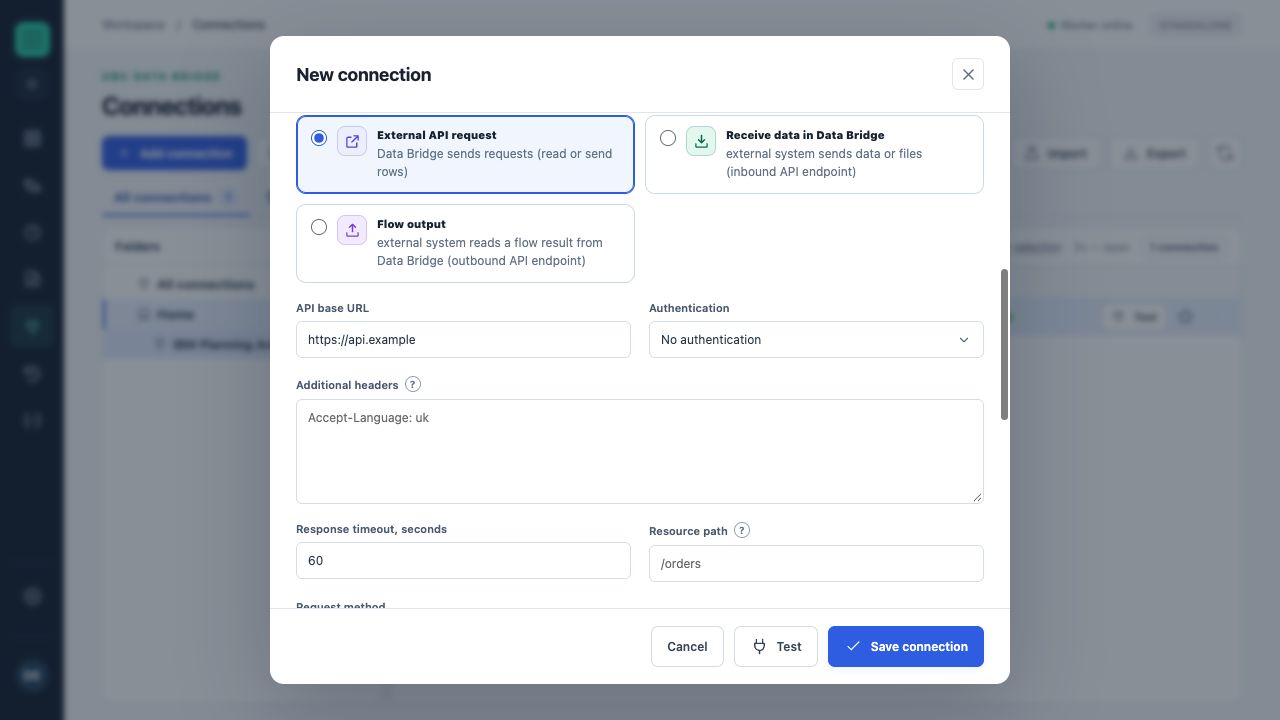
The upper part of the REST API form: name, service, base address, authentication and additional headers. api.example is a training address.
For REST API, the resource address, method, query parameters and response parsing are configured in the connection. Create another connection for a different resource or method. A source block can add its own selection parameters; a destination constructs the body from table rows.
Reading
A source supports GET and POST. Response formats are JSON, XML, CSV/TSV and JSON Lines, with optional detection from Content-Type. For a nested JSON array, set the record path; for XML, the element path. Check encoding, CSV delimiter and header.
Response pages
| Mode | What to configure |
|---|---|
| none | One response. |
| next_link | The next-link path in JSON/XML. |
| page | The page parameter name and page size. |
| offset | The offset parameter and batch size. |
A next-page link from the response body is not used for CSV or JSON Lines. Limit the maximum volume so a pagination error does not cause excessive reading.
Sending
A destination supports POST, PUT and PATCH. The body can be JSON, XML, form data or CSV. Rows are sent individually or in batches; form data allows one row per request. For individual records, the resource path can use a template /orders/{{Номер}}.
OData
For Dynamics 365 and 1C, select an entity set, fields and filter. Arbitrary SQL queries are unavailable for these connections. Updates require key fields. Specific permissions and available entities depend on the external system's configuration.