System diagram
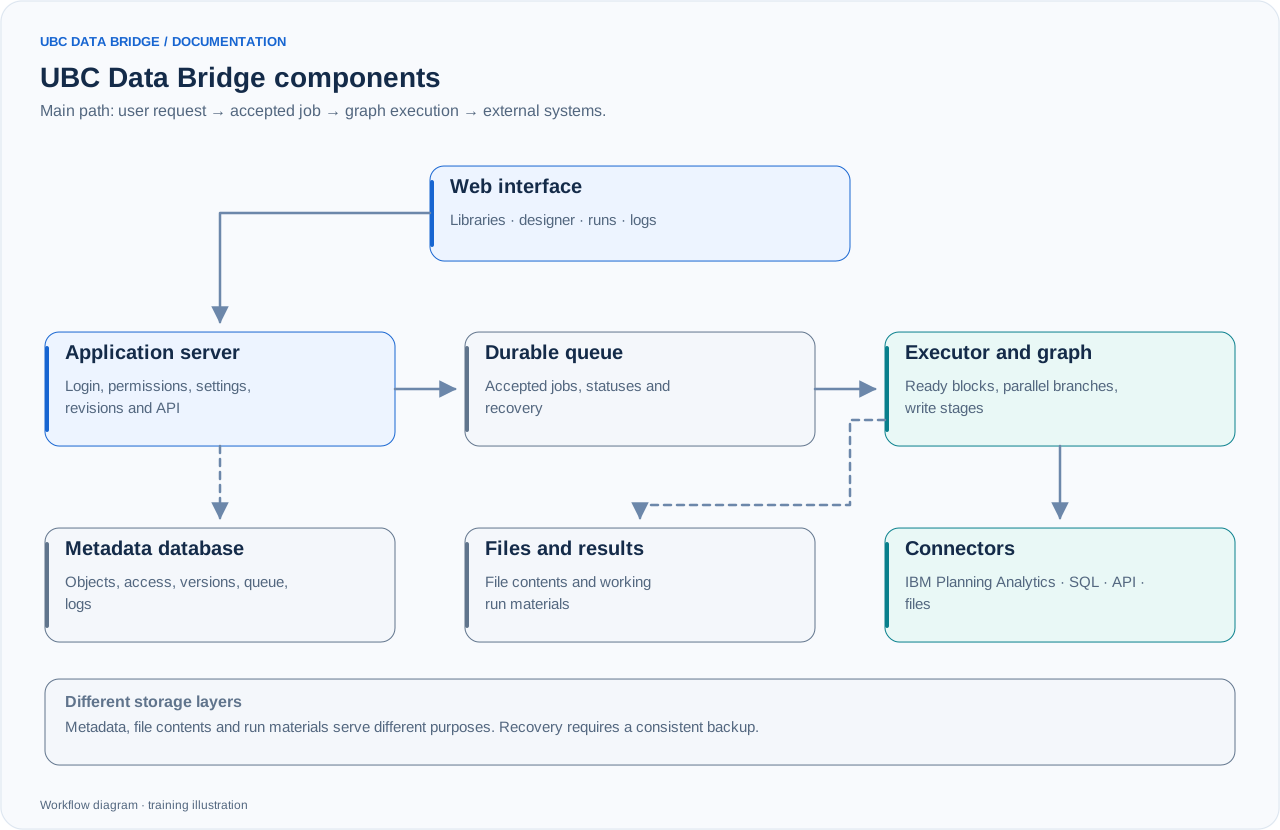
Main components and the direction of request processing. Dashed lines indicate storage access; the diagram summarizes relationships rather than listing every internal call.
The diagram shows the main components and a job's path from the web interface to external systems. Each component's purpose is described below.
Component map
| Component | Purpose | What the user sees |
|---|---|---|
| Web interface | Displays libraries, the canvas, parameters and results. | One workspace for preparing and running flows. |
| API server | Validates requests, permissions, revisions and settings. | Access control, saving and diagnostics. |
| Durable queue | Retains jobs until execution and guards against accepting the same request twice. | Queued, running and waiting statuses. |
| Executor | Processes jobs and supports heartbeat, cancellation and recovery after failures. | Execution progress and a reliable outcome. |
| Graph scheduler | Identifies ready blocks, independent branches and write stages. | Reproducible step dependencies. |
| Connectors | Read objects and prepare writes to a particular system. | Connection fields and object selection. |
| Result storage | Stores run tables and prepared data. | Output previews and diagnostics. |
| Job scheduler | Determines the next run and changes in monitored sources. | Schedules and automatic-run history. |
Separating metadata and data
The shared database stores object definitions, permissions, revisions, the queue and logs. Uploaded file content is stored outside that database. Tables and materials for a particular run have separate temporary or working storage. A database-only backup is therefore not a complete system backup.
Responsibility boundaries
UBC Data Bridge controls processing order and validates operations, while external services retain ownership of their data and access rules. There is no global transaction across a cube, SQL database and message. If some external actions are already confirmed, a later error does not automatically roll them back.
Private-network resources, APIs and composition
UBC Data Bridge Agent runs near private-network resources and establishes an outbound protected channel. The server sends permitted operations through it; agent configuration limits addresses and folders. Inbound APIs accept external-client requests, while publications expose process results. Subflows perform reusable processing inside the current run; flow calls create separate child executions. Each mechanism applies its access rules and is verified in the relevant environment.