Metadata database
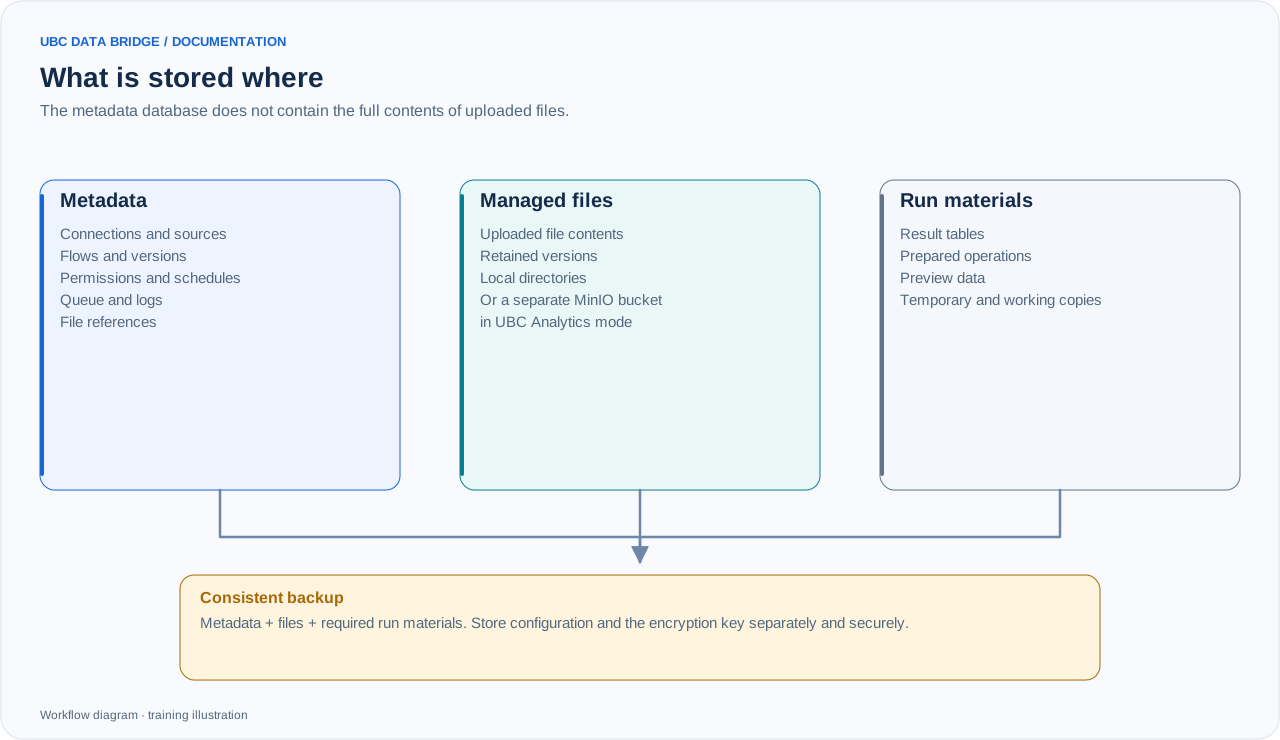
Three storage categories. A database reference does not replace the file itself; backups must cover the required categories and encryption key.
The database contains connections, sources, flows, drafts and Production versions, roles and permissions, schedules, the run queue, logs and file references. A standalone installation can use SQLite or PostgreSQL. In UBC Analytics mode, the system uses the corresponding environment's PostgreSQL database.
Each UBC Analytics environment has two separate schemas: databridge_builder for “Flows” and databridge_main for “Integrator”. Objects and files in one section do not automatically become available in the other.
Files
File contents are not stored in the shared metadata database. Local mode uses managed-file directories. MinIO mode uses a separate UBC Data Bridge bucket; working copies remain on disk for processing. Downloaded copies are checked by size and checksum.
Versions and space reclamation
A new file version must not disrupt an accepted run: it uses its fixed reference. Old materials are deleted only after checking that no versions, sources or active runs reference them. Reducing the retained-version count can delete historical versions across all files in the workspace.
Backup
- Keep a consistent backup of metadata, managed files and required run materials.
- Securely preserve the encryption key and configuration: stored connection secrets cannot be restored without the required key.
- For MinIO, include the required bucket and verify access after restoration.
- Test restoration in a separate environment with a small read-and-export flow.