Job types
| Type | Setting | Example |
|---|---|---|
| Cron schedule | Five fields and an IANA time zone. | 0 8 * * 1-5 — weekdays at 08:00 in the selected time zone. |
| Interval | A period of at least 60 seconds. | Every 3,600 seconds. |
| Source change | A list of sources or supported blocks, polling interval and stabilization delay. | Check every 60 seconds; start after 30 seconds of a stable state. |
Creating a job
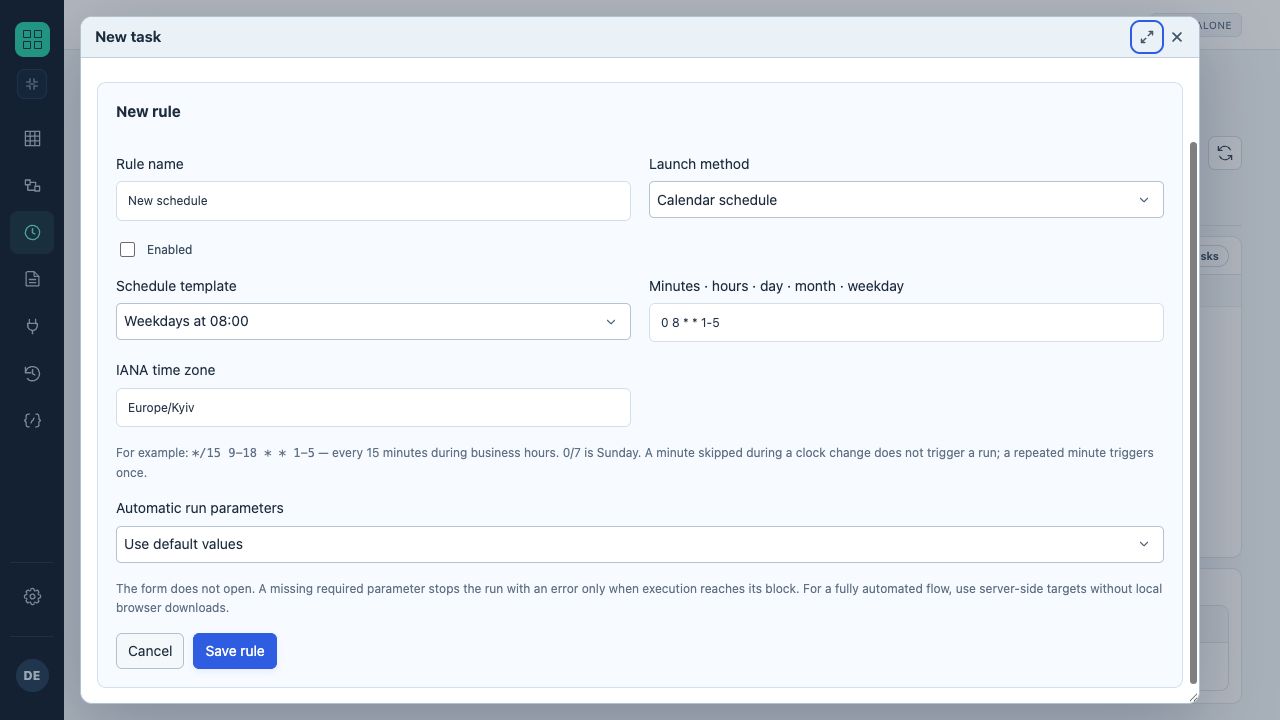
Example calendar schedule for weekdays at 08:00 in Europe/Kyiv. The “Enabled” switch is off; the rule is not saved.
- Publish the flow to Production.
- Open “Jobs” and create a new rule for the flow.
- Choose the type, time zone and run parameters.
- Enable the job and check the next run time.
- Review the first trigger's history and the result in the target system.
Parameters and permissions
A job can use default parameter values or specified overrides. The enable switch does not change configuration or the execution user. Job management is available to the administrator. If permissions or dependencies change, automatic execution may be rejected.
Limit
- A Production version is required.
- An IBM “From user session” connection is unsuitable for unattended execution.
- Current form-record context is absent in scheduled execution.
- Steps requiring manual choices or file uploads need a carefully designed scenario; an automated job does not answer on a person's behalf.
Time zones
Set the time zone explicitly, for example Europe/Kyiv. Cron uses that zone's local time. A nonexistent time during the daylight-saving transition is skipped; a repeated local minute is handled at its first occurrence. Check the next run after modifying a schedule.
Unattended processes
Schedules and “Call flows” need complete parameter values: supply them explicitly or provide defaults. Manual file uploads, choices and user sign-in must not block the unattended branch. For one reusable flow, add “Route by launch method” and configure “Other launch methods” for scheduled execution. If another process must follow a write, connect its call to the destination’s success output and enable completion waiting where sequencing is required.